
B.Sc. in Law
Program Profile
The Bachelor of Law provides progressive study of public and private law, constitutional and administrative law, criminal and civil law, international law, human rights, commercial and personal-status law, legal procedures, and legal research.
The programme is designed to develop legal analysis, research, legal communication, ethical and socially responsible practice, and professional readiness. Digital legal competencies, teamwork, and practical assessment have been identified for further development.
Occupational profiles of graduates
The programme is intended to prepare graduates for legal functions in courts and related legal services, legal departments of ministries and public institutions, private-sector organizations, and civil-society and human-rights organizations.
Regulated professional practice (including advocacy) remains subject to the applicable licensing and professional requirements.
This profile reflects the Department of Law mission and the programme objectives; it does not guarantee employment or professional registration.
Qualification awarded
Bachelor of Law (B.A. in Law).
Length of programme
5 Years
Number of credits
199 ECTS credits
Mode of Study
Full time on campus
Read more about the programme
Get detailed information about the programme requirements, courses, credits, and educational objectives as a PDF file.
Program Educational Objectives (PEOs)
- Equip law graduates with comprehensive knowledge of legal disciplines in both public and private law divisions, preparing them to understand and practice law effectively.
- Develop graduates' skills in analysis, critical thinking, legal reasoning, and research to cultivate a sound legal aptitude.
- Provide graduates with scientific legal skills to apply them practically through field training, enhancing their readiness to work in professional legal environments.
- Consolidate ethical values, a sense of responsibility, principles of justice, and the defense of rights.
- Enable graduates to leverage their legal understanding to pursue continuous learning, keep pace with the evolution of legal systems, and contribute actively to legal reforms and societal problem-solving through interdisciplinary perspectives.
Program Learning Outcomes
- Apply legal principles across diverse legal branches and specializations to contribute to analysis and the adoption of arguments regarding legal cases.
- Communicate legal knowledge effectively in a manner appropriate for all institutions and diverse community segments.
- Maximize the effective use of legal research to contribute to resolving cases and developing legal systems.
- Utilize legal aptitude in legal analysis and case studies, interpreting them in light of legal reasoning to solve problems with high efficiency.
- Employ appropriate legal software, databases, and digital tools to support legal research for resolving cases.
- Adhere to ethical values, principles of justice, and professional responsibility in legal practice and decision-making.
- Collaborate effectively within interdisciplinary teams, manage legal projects, and demonstrate leadership skills in legal and community environments.
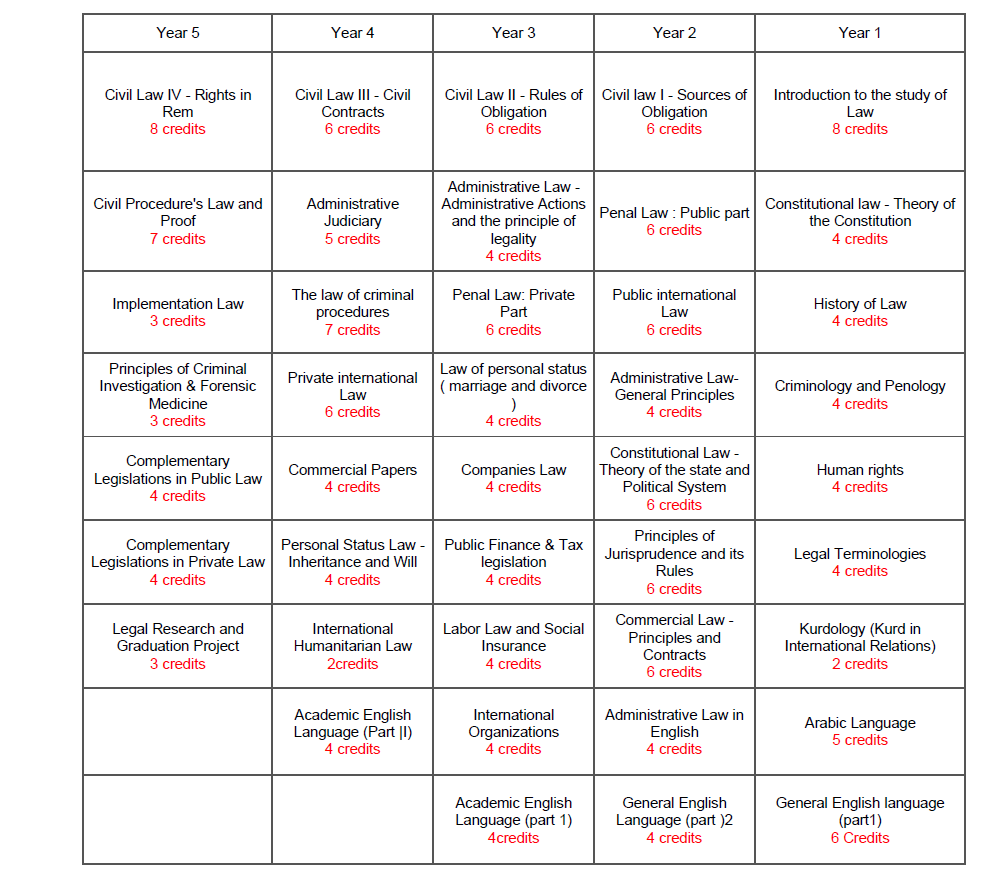
Programme structure diagram with credits
Yearly Timeline
Sept. 1, 2026
⚠️ First year students start around mid-October
⚠️ First year students start exams around 20 of January
July 1, 2027
Check out the full academic calendar on UoD's webstie.
Programme Coordinator

Professor in private Law/ private International Law
Law
College of Law
University of Duhok
Apply to the Programme
Public undergraduate admissions in the KRG region are managed centrally by the Ministry of Higher Education through the online ZankoLine portal (regayzanko.com). After Grade 12 Baccalaureate results are released, high schools provide students with unique login credentials to rank their preferred universities and B.Sc. majors during a 10–14 day registration window. Final placement is automatically determined by the student's Grade 12 average, subject choices, and department capacity.